
Publish with us… SUBMIT YOUR MANUSCRIPT: https://czasopisma.uafm.edu.pl/pis/about/submissions;
From 2026, the journal will use APA style.
The journal publishes articles in English. It is possible to publish in Polish.
Articles may be submitted in the following categories:
– original works,
– case studies,
– review articles,
– review articles,
– memoirs.
Information for Authors
UWAGA: The editorial board does not accept or refer for review articles that are not prepared in accordance with the instructions.
The decision to publish a text depends on the opinions of two reviewers. The editorial board reserves the right to shorten texts intended for publication.
Instrukcja przygotowania artykułów
General rules
Article length: 40,000 characters for original works, case studies, and review articles; 20,000 characters including spaces for review articles and memoirs (without footnotes);
File format: .doc or .docx
When submitting an article, the author should attach the following files:
• A file with a title page containing:
– the name and surname of the author(s),
– the academic degree/title of the author(s),
– affiliation (name of the university, hospital or other institution to which the author is affiliated),
– ORCiD identifier,
– author’s e-mail address for correspondence (published),
– information about the contribution of individual authors,
– declaration of use of artificial intelligence,
– information about funding,
– statement of conflict of interest,
– consent of the bioethics committee,
– information about access to detailed data from the author for correspondence.
• File with the article containing:
– title of the article in Polish and English,
– abstracts in Polish and English (maximum 250–500 words each) and keywords (3–5) other than the words used in the titles in Polish and English,
– bibliography:
– for original works, max. 30 items,
– for case reports, max. 15 items,
– for review articles, max. 60 items.
• A file with a cover letter signed by the corresponding author.
The text of the article should be written in Times New Roman font, size 12, with 1.5 line spacing. Foreign terms and expressions, as well as titles of articles and books, should be written in italics; do not use bold or underlined font. Please use abbreviations (e.g., r., w., etc.) consistently throughout the article.
The article should be divided into sections with subheadings.
• The text of original works should be divided into five parts: Introduction, Materials and Methods, Results, Discussion, Conclusions. The length of the Introduction should be limited to the information necessary to justify the purpose of the research and the analysis of the results presented. Abbreviations used in the work should be listed before the introduction or explained when first used in the text.
• Review papers and review articles should include: Introduction, chapter titles related to the topic discussed, Summary.
• Case reports should include: Introduction, Case description, Summary.
The introduction should specify the purpose and significance of the work, describe the study in a broader context, and indicate why it is important.
The summary should contain a highly synthetic overview of the topic discussed in the work and should not exceed 500 characters with spaces.
There is no need to number subheadings.
Images, Illustrations
Drawings and photographs should be pasted into the text at the point of reference and provided in separate graphic files (300 dpi) in one of the following formats: *.jpg, *.bmp, *.tif or *.psd.
Illustrations taken from other works and subject to copyright protection should be accompanied by bibliographic information in the form of a reference to the literature, placed in the caption of the drawing.
Please number figures and photographs, which should be announced in the text – in a full sentence or as (figure/photograph 1).
Charts and tables
Please number tables and charts separately.
Charts should be prepared in greyscale (if possible, do not use colours). Please avoid three-dimensional charts due to their reduced readability. Charts should be provided in separate Excel files.
Each table and chart must have a title.
Notes to the table content should be placed inside the table, footnotes to the figure – below the figure.
The full source must be provided below each table and chart. The following terms are acceptable: ‘own work’ or ‘own work based on…’.
Each table/graph should be announced in the text – in a full sentence or as (graph 2), (table 1), which allows the table/graph to be placed in a convenient location for the author and publisher.
It is advisable to avoid abbreviations in table columns.
The text in the table should be in a smaller font than the basic font. Any explanations should be placed directly below the table.
Numerical data units should be given in square brackets.
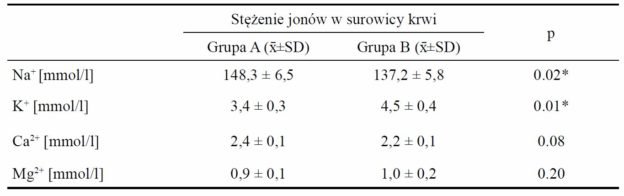
The preferred format is a table without vertical lines separating columns, containing horizontal lines at the top and bottom, a horizontal line separating column headings from data, and optional horizontal lines separating rows of data or complex column headings (example below).
Instructions for preparing APA-style reference lists
Detailed rules for reviews
1. Each publication is assessed by at least two independent reviewers from outside the institution with which the author is affiliated.
2. The recommended approach is a model in which the authors and reviewers do not know their identities (i.e. double-blind review process).
3. In other cases, the reviewer must sign a declaration of no conflict of interest; the conflict of interest between the reviewer and the author is considered when one of the following situations is true:
a) direct personal relationships (kinship, legal relationships, conflict),
b) relationships of professional subordination,
c) direct academic cooperation during the last two years preceding the preparation of the review.
4. The review must be in writing and must conclude with an unambiguous statement as to whether the article can be published or rejected.
5. The rules of qualifying or rejecting a publication and a possible review form are made public on the journal’s website or in each issue of the journal.
6. The names of the reviewers of individual publications/issues are not disclosed; once a year, the journal publishes a list of cooperating reviewers.
Statement
Out of concern for academic integrity and the overall quality of published papers, the editorial board and the publishing house operate specific procedures geared towards preventing cases of ghost-writing. Both ghost-writing and guest authorship are examples of gross academic misconduct.
Ghost-writing occurs when the author (or co-author) of a publication has made a major contribution to its coming into being and yet does not reveal his/her participation as one of the legitimate authors thereof, or his/her role is not mentioned in the credits and acknowledgements section of the book.
As far as guest authorship is concerned, in spite of the fact that an individual has been mentioned as the author or co-author of a given publication, his/her actual role in the creation process is minor or none.
Please note that any identified case of ghost-writing and/or guest authorship shall be made public, and the relevant authorities will be notified without delay. In addition, all manifestations of academic misconduct will be duly documented for legal reasons.